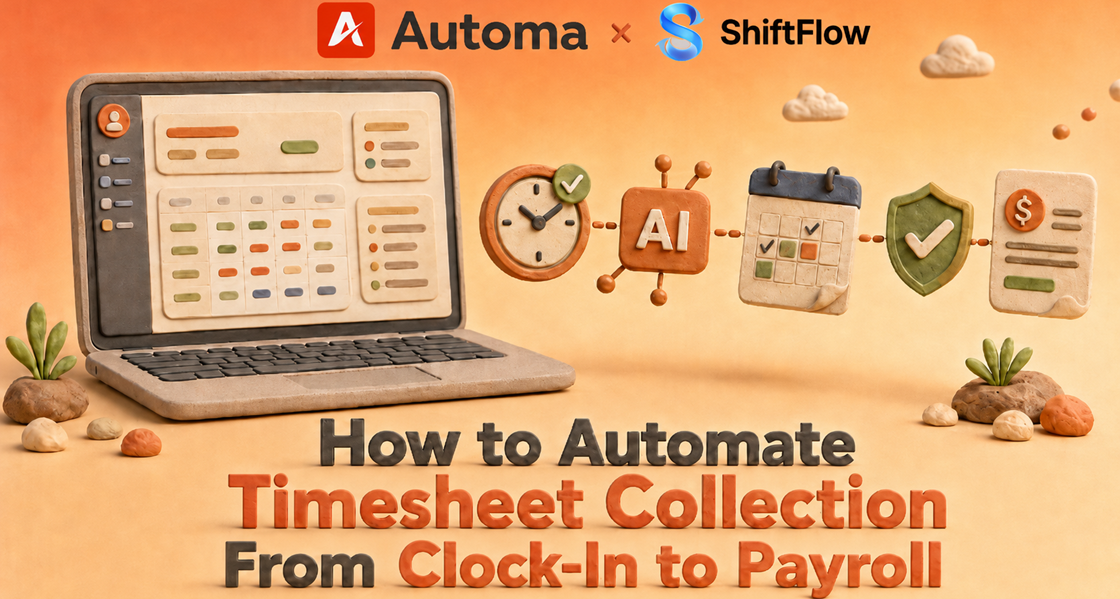
To automate timesheet collection means using a digital workflow to capture clock-ins, verify site attendance, flag exceptions, approve corrections, and prepare records for payroll. This matters most for field and shift-based teams because the work happens away from a central office. A janitorial team might have a cleaner forget to clock out after a night shift, a supervisor trying to verify which building a replacement worker covered, and a payroll team holding the hours but missing the pay code, client account, cost center, or approval note for the pay run.
Most businesses with field teams need two layers of automation. The first layer captures attendance at the job site or client site. The second layer moves approved records into payroll and operations systems, where errors often come from missing fields, late approvals, or repeated manual entry.
What breaks before payroll close?
Field work is distributed and often hard to verify in real time. That may mean cleaners working after hours, construction crews moving between job sites, security guards covering different posts, or service technicians visiting customer locations. For a janitorial company, one supervisor may oversee several office buildings while evening crews clock in across different client sites after business hours.
Payroll close becomes fragile when time records are missing the fields payroll needs. A forgotten clock-out, wrong client site, late supervisor approval, missing break status, or wrong cost center can stop the pay run. The same thing happens when corrections live in chat or email instead of being attached to the time record.
The issue is not only whether the employee worked. The issue is whether the approved record is complete enough for payroll to submit without rebuilding the timesheet.
How should manual and automated timesheet workflows differ?
Manual workflows discover problems late. Automated workflows surface them before payroll is under pressure.
Area | Manual Tracking | Automated Workflow |
Clock-in | Written later or entered by a supervisor | Employee clocks in from the job site |
Location | Hard to verify | GPS or client-site verification |
Identity | Relies on memory or trust | Employee account or selfie confirmation |
Exceptions | Often found late, near payroll close | Missing punches, late arrivals, and overtime are flagged early |
Payroll prep | Payroll copies hours into another system | Approved records become payroll-ready timesheets |
Downstream work | HR, ERP, and reports are updated separately | Workflow automation moves approved records forward |
The value comes from a more reliable payroll handoff. Each approved record should reach payroll with the right fields, review status, correction notes, and source context.
Where do ShiftFlow and Automa each fit?
ShiftFlow sits at the time tracking layer. It captures job-site attendance through mobile clock-ins, GPS verification, selfie confirmation, scheduling, time-off requests, anomaly detection, and payroll-ready records. For field teams, this is the source record: who clocked in, where, for which shift, and whether the entry needs review.
Automa sits downstream after a timesheet is approved, especially when approved records still need to move into payroll portals, HR systems, ERP fields, client reports, shared spreadsheets, or archives that do not sync cleanly by API. If there is no native integration, that handoff can still run through exported files, structured spreadsheets, or portal-based automation.
What should a payroll-ready timesheet contain?
Payroll-ready timesheets should carry the information payroll, finance, and operations need to calculate pay, allocate labor, and review exceptions. For a cleaning route, a record should not only say "Maria worked 8 hours." It should show where those hours belong, how they should be paid, and whether anything requires review.
Approved timesheet field | Payroll / ERP destination | Review rule |
Employee ID | Worker profile | Must match an active employee |
Site ID | Client-site record | Must match scheduled site |
Client account | Customer or contract record | Required for client labor reporting |
Job code | Payroll or ERP job field | Required when labor is billed by job |
Cost center | Finance or ERP field | Required for internal labor allocation |
Pay code | Payroll earnings code | Review if special shift, holiday, or overtime |
Regular hours | Payroll hours | Can submit if approved and no exception |
Overtime hours | Payroll overtime field | Should stay human-reviewed |
Break status | Time and attendance record | Review if break is missing or policy conflict appears |
Approval status | Payroll review queue | Submit only after supervisor approval |
Exception note | Audit trail | Required for corrections |
Pay period | Payroll run | Must match payroll calendar |
In the United States, the Department of Labor says covered employers must keep records that include identifying employee information, hours worked, and wages earned. DOL guidance also notes that payroll records are generally kept for at least three years, while time cards and schedules should generally be retained for two years.
Those rules are U.S.-specific, but the operational lesson is broader: payroll-ready records should preserve the fields payroll needs to calculate, review, and defend the record.
How does one cleaning route move from clock-in to payroll review?
Consider a single evening cleaning shift.
Maria is assigned to Site A, a medical office that needs evening cleaning from 8:00 PM to 4:00 AM. Her shift belongs to the current pay period and uses a required break rule.
At 7:58 PM, Maria clocks in from her phone. The GPS point falls inside the approved geofence for Site A, and her selfie confirmation matches her employee account. The time tracking system now has the core context payroll will need later: Maria's employee ID, the Site A record, the shift ID, scheduled start time, pay period, break rule, supervisor owner, and client account.
During the shift, Maria takes the required break. The break is attached to the same shift record.
At the end of the night, Maria forgets to clock out. The system flags the missing clock-out and sends a reminder to Maria and her supervisor. The supervisor checks the site log, confirms Maria left at 4:03 AM, corrects the clock-out, adds a note, and approves the record.
Now the record enters the payroll review queue. Payroll sees the approved hours, correction note, pay code, client account, cost center, and pay period. Payroll reviews the exception, but it does not have to retype every clean field from scratch.
After approval, the downstream automation can continue the handoff. A downstream Automa workflow can be configured to read the approved export, enter Maria's regular hours into the payroll portal, attach or save the correction note as an audit reference, update the Site A client labor report, and archive the payroll-period record. If the pay code or cost center is missing, the workflow stops and sends payroll a notice with the employee ID, site ID, pay period, and missing field instead of submitting an incomplete record.
The same pattern applies beyond cleaning: time tracking captures attendance data at the work site, while workflow automation handles the approved-record handoff.
What happens when the payroll system has no API?
Many small and medium-sized businesses use payroll, HR, ERP, reporting, and client billing tools that do not sync cleanly. Sometimes the payroll system has an API. Sometimes it does not. Sometimes the export is clean, but the ERP or client report still needs manual entry.
Automa is useful when approved time data still needs to move across systems that do not sync cleanly by API. In a no-API payroll handoff, the approved timesheet export is generated first. A downstream workflow checks required fields such as employee ID, pay code, client account, job code, cost center, hours, approval status, and pay period. If a pay code or cost center is missing, the workflow stops and notifies payroll instead of pushing an incomplete record forward.
Clean records can then move into the payroll portal, with regular and overtime hours entered into the right fields. The portal confirmation is saved, ERP labor-cost fields are updated, the client labor report is refreshed, and the approved export, correction note, and confirmation are archived. Exception records stay in the payroll review queue until a payroll owner or supervisor resolves them.
Automa-style RPA workflows are useful for this repetitive cross-system handoff. Payroll judgment still belongs with payroll owners; automation removes the repeated copying, checking, reminder sending, and archiving that happens after supervisor approval.
Once attendance records are reliable, business operations automation can carry those approved records through the repetitive steps that follow.
Which parts should stay human-reviewed?
Automation should make exceptions visible, but not every exception should be automatically approved. A GPS mismatch can come from location drift, weak signal, or two nearby buildings, so it should be treated as a review trigger rather than automatic misconduct. A forgotten clock-out usually needs a supervisor to compare the site log, employee response, and scheduled shift before correcting the end time.
Overtime, break exceptions, emergency shift changes, and repeated anomaly patterns also deserve human review. Overtime affects labor cost and may require policy or client-contract approval. Break exceptions can depend on local labor rules. Replacement coverage needs to match the actual client-site assignment. Repeated corrections may point to a training issue, a scheduling problem, or a supervisor approval bottleneck.
Automation detects, routes, reminds, and records. Supervisors and payroll owners make the sensitive decisions.
When should businesses use time tracking software and workflow automation?
Businesses should use time tracking software when they need to capture job-site or client-site attendance reliably. The basics are straightforward: mobile clock-in and clock-out, GPS verification, selfie confirmation, scheduling, time-off requests, automatic timesheets, anomaly detection, overtime and break rules, and real-time access across phones, desktop, and web. For this layer, time tracking software such as ShiftFlow is useful when field and shift-based teams need those basics in one app.
After time is approved, workflow automation is worth considering if payroll still re-enters approved hours, HR automation, ERP, and reporting workflows still need manual updates, and every pay period still involves copying, checking, confirming, archiving, or chasing exception approvals.
It is too early for downstream automation if clock-in data is unreliable, pay codes are undefined, cost-center rules are unclear, or supervisor approvals are inconsistent. Fix the source record first, then automate the handoff.
How should teams measure whether the workflow is working?
Timesheet automation should be measured by cleanup reduction, not just app adoption.
The strongest signals are operational: missing punch rate, GPS mismatch rate, payroll correction rate, supervisor review time, payroll close time, overtime exception volume, late approvals, and manual payroll entry hours. Teams should also watch the time from shift end to payroll-ready status and the percentage of records submitted without correction.
These metrics are safer than broad promises. A successful rollout should reduce correction work, shorten review cycles, and make approved records available earlier.
How should a business roll this out?
Start with one high-volume field team or route instead of redesigning every attendance process at once. A cleaning route is a good pilot if it has recurring shifts, multiple client sites, and regular payroll corrections. Choose one team, region, or client-site type, then define the required fields: employee ID, client site, shift, clock-in, clock-out, break, approval, pay code, and cost center. Replace paper timesheets or Excel first, and track whether missing punches, late entries, payroll corrections, and supervisor review time actually improve.
Once the source record is reliable, add payroll, HR, ERP, and reporting automation. The final layer is standardization: exception rules, approval reminders, audit logs, and archive workflows should work the same way every pay period.
If approved hours are still re-entered manually after time is captured digitally, the handoff is the best place to start.
Conclusion
Start with one high-volume field route. Prove that clock-ins, corrections, approvals, and pay codes are reliable. Then automate the handoff into payroll, HR, ERP, and reporting systems. That is how businesses automate timesheet collection as a payroll workflow, not just a digital timesheet.
FAQ
Can timesheet automation work if our payroll system has no API?
Yes. When a payroll system does not support an API, RPA can help move approved hours into browser-based portals or structured spreadsheets. Payroll should still review exception records before submission.
What should payroll review before approved hours are submitted?
Review employee ID, client site, shift ID, regular hours, overtime hours, break status, pay code, client account, cost center, approval status, and exception notes.
How should teams handle forgotten clock-outs?
Flag the record as an exception. A supervisor should review the site record, contact the cleaner if needed, correct the time entry with a note, and approve the record before payroll.
Is GPS time tracking legal for field employees?
Rules vary by location. Businesses should review local labor and privacy laws, notify employees about location tracking, limit collection to work-related use, and define retention and access policies.
What is the difference between ShiftFlow and Automa in this workflow?
ShiftFlow is the time tracking example: it captures job-site or client-site attendance data. Automa is the downstream automation layer: it helps move approved records into payroll, HR, ERP, reporting, and archive workflows when systems do not sync cleanly.