Agentic automation is the application of AI agents—software entities capable of perception, reasoning, and action—to execute complex business processes without constant human oversight. Unlike a standard chatbot that answers questions, an agent does work.
Think of it as a shift in the "Levels of Autonomy."
Level 1 (Scripted): Standard RPA. "Click here, type this."
Level 2 (Co-Pilot): GenAI assists a human. "Draft this email for me."
Level 3 (Agentic): The system plans and executes. "Resolve this shipping delay by checking inventory, emailing the carrier, and updating the CRM."
What is agentic process automation?
At its heart, agentic process automation replaces the hard-coded "happy path" of RPA with a probabilistic "reasoning loop." When an agent encounters an error—say, a missing field in a dataset—it doesn't crash. It queries the context, looks for the data elsewhere, or asks a human for clarification, then resumes its work.
This shift is critical because legacy automation is failing at scale. According to Gartner, nearly half of all RPA projects fail to deliver sustainable ROI because they break whenever the underlying application interface changes. By switching to an agentic workflow, you move from "brittle scripts" to "adaptive reasoning," drastically reducing the maintenance burden.
How agentic AI differs from standard generative AI?
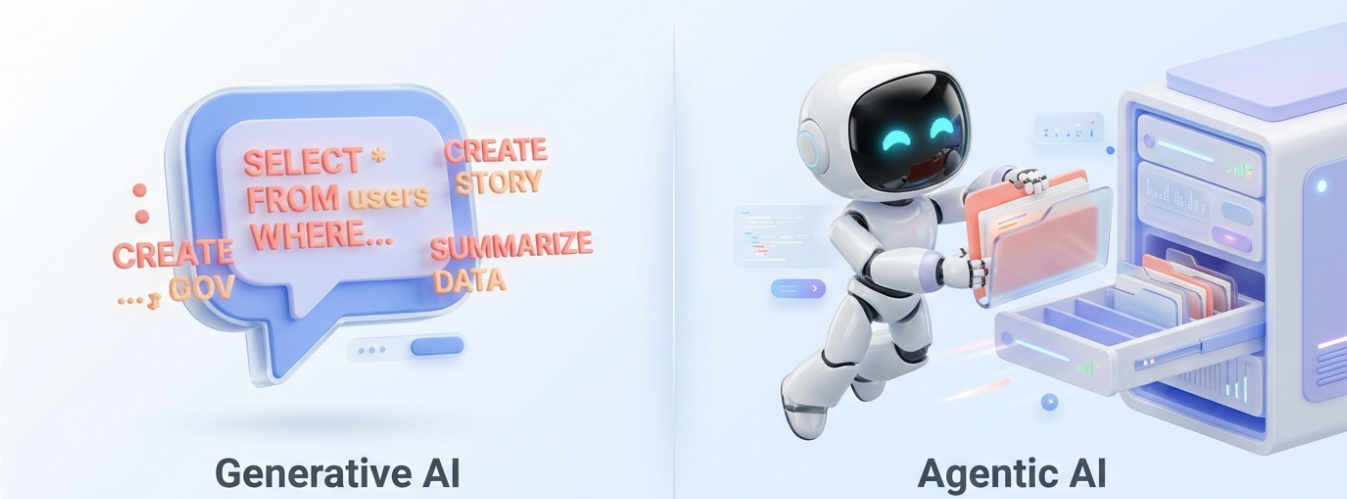
Generative AI creates content. Agentic AI creates outcomes. If you ask ChatGPT to "write a SQL query," that is Generative AI. If you give a system access to your database and say "find the top-selling product and email the report to the sales VP," that is Agentic AI. The technical differentiator is the Large Action Model (LAM) concept. While LLMs (Large Language Models) excel at processing text, agents wrap these models in an orchestration layer that allows them to call functions, execute code, and interact with APIs. They don't just predict the next word, they predict the next action.
Agentic Automation vs RPA
The industry loves to pit these two against each other. That is a mistake. They are not enemies, they are different organs in the same body. RPA is the Hands. Agentic Automation is the Brain. You need hands to type, click, and move data. You need a brain to decide what to type when the input is ambiguous.
Quick Comparison
To understand where to deploy each technology, review the architectural differences below:
Feature | Traditional RPA (The Hands) | Agentic Automation (The Brain) |
Core Logic | Deterministic (If/Then/Else) | Probabilistic (Reason/Plan/Act) |
Data Input | Structured only (Excel, SQL, Forms) | Unstructured (Email, PDF, Slack, Voice) |
Exception Handling | Fails on error; requires human fix | Self-corrects or retries with new parameters |
Maintenance | High (Brittle to UI changes) | Low (Adapts to UI/API changes) |
Cost Model | Fixed License (Per Bot) | Variable Consumption (Per Token) |
Best Use Case | High-volume, repetitive data entry | Complex, variable decision-making |
Limitations of rule-based robotic process automation
RPA is deterministic. Input A must always lead to Output B. This is perfect for high-volume, standardized tasks like payroll processing. But it is fragile. A slight change in the digital environment breaks the bot. Industry data supports this observation: Forrester reports that maintenance costs for RPA can surpass the initial deployment costs by 3x over a two-year period due to "break-fix" cycles. If your data is unstructured or your UI is volatile, RPA becomes a liability.
Why agentic workflows handle unstructured data better?
Agents thrive on chaos. Because they use LLMs to parse information, they can read a messy email, extract the intent, and map it to a structured JSON object for your ERP system. Consider a "Claims Processing" workflow.
RPA: Fails if the customer uploads a photo of a receipt instead of a PDF.
Agentic Workflow: Uses Vision API to read the receipt, extracts the date and amount, cross-references it with the policy, and approves the claim.
The Agentic Tech Stack
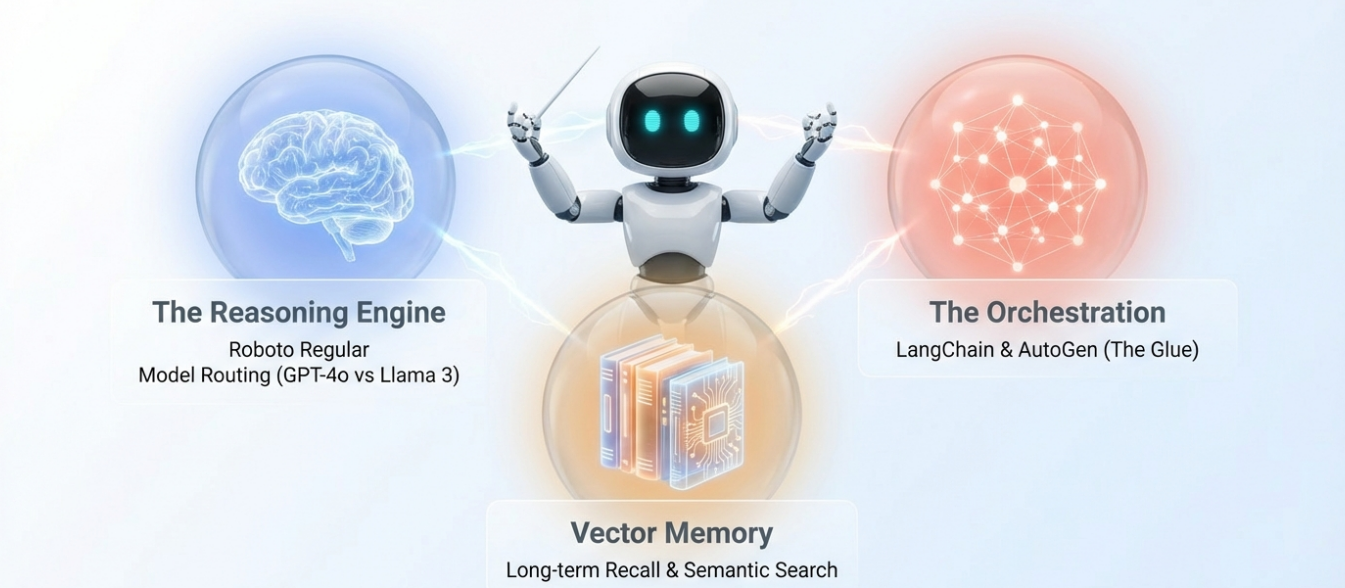
Before implementing, you must understand the architecture. An agent isn't a single piece of software. It is a stack. To build a functional agentic workflow, you need to assemble the following components.
The Orchestration Framework
The framework provides the "glue" that connects the LLM to your data and tools.
LangChain: The industry standard for building single-agent applications. It excels at chaining prompts and managing memory.
AutoGen (Microsoft): Best for Multi-Agent Systems. If you need a "Coder Agent" to talk to a "Reviewer Agent," AutoGen handles the conversational hand-offs.
CrewAI: A role-based framework that allows you to assign specific personas (e.g., "Senior Researcher," "Data Analyst") to agents, making it easier to conceptualize complex workflows.
The Reasoning Engine (The Model)
Not all models are created equal. You must implement Model Routing to balance cost and intelligence.
The "Heavy Lifters" (GPT-4o, Claude 3.5 Sonnet): Use these for the planning and reasoning steps. They have high accuracy but high token costs.
The "Speedsters" (Llama 3, Haiku): Use these for summarization, formatting, or simple classification tasks. They are cheap and fast.
Vector Memory (Long-Term Recall)
Standard LLMs have a limited context window. To make an agent "remember" a customer's history from six months ago, you need a Vector Database (like Pinecone, Milvus, or Weaviate). This converts text into numerical vectors, allowing the agent to perform semantic searches across millions of documents in milliseconds.
Buy vs. Build
Should you code your own agents using LangChain, or buy a platform?
Factor | Build (Open Source / Custom) | Buy (Enterprise Platform) |
Time to Value | Slow (Months). Requires engineering resources. | Fast (Weeks). Pre-built connectors. |
Customization | Unlimited. You own the code. | Limited by platform capabilities. |
Maintenance | High. You manage API breaks and updates. | Low. Vendor manages infrastructure. |
Security | You control the data pipes. | You must trust the vendor's compliance. |
Best For... | Core product features or unique IP. | Internal ops, HR, Finance, IT Support. |
Top Use Cases for Agentic Automation
Where should you start? Look for processes with high variability and unstructured inputs.
Revolutionize customer service
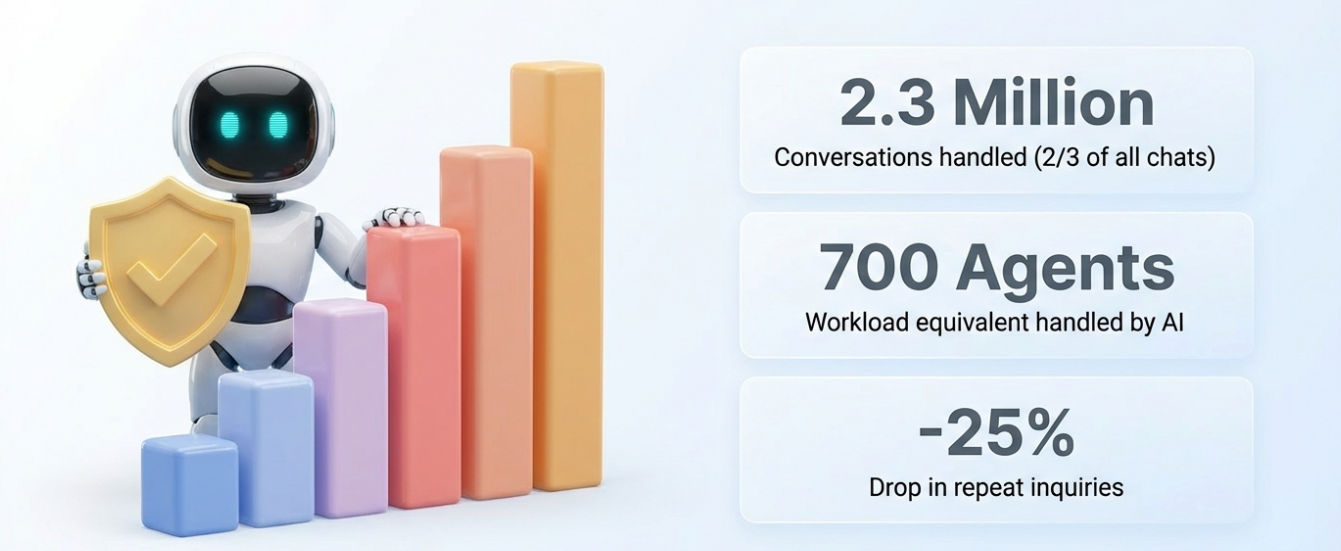
The most prominent example of agentic success in 2024 comes from Klarna. They didn't just deploy a chatbot, they deployed an AI assistant capable of handling end-to-end disputes and refunds.
The Challenge: High volume of repetitive queries (refunds, returns, payment issues) clogging up human support queues. The Agentic Solution: Klarna deployed an OpenAI-powered agent integrated into their app to handle disputes, refunds, and multilingual support 24/7. The Results:
Volume: The agent handled 2.3 million conversations in its first month (two-thirds of all customer service chats).
Efficiency: It did the equivalent work of 700 full-time agents.
Outcome: Repeat inquiries dropped by 25%, and resolution time plummeted from minutes to seconds.
Streamline finance and invoice reconciliation
Finance teams drown in "exceptions." An invoice doesn't match the PO by $0.05. The vendor address changed. Agentic process automation excels here. The agent reads the invoice, compares it to the PO, identifies the discrepancy, and decides if it falls within the "auto-approval threshold" (e.g., <$10). If yes, it approves. If no, it drafts an email to the vendor asking for a credit memo.
Automate IT operations and security incident response
Security is a speed game. When a SIEM alert triggers, an agent can instantly isolate the infected endpoint, pull the browser history, and cross-reference the IP address with threat intelligence feeds. It prepares a full forensic report for the CISO before a human analyst has even opened their laptop.
5-Phase Guide to Implement Agentic Workflows
Do not rip and replace. Build a parallel track. A "Big Bang" implementation will likely fail due to hallucinations or unexpected edge cases. Follow this phased rollout protocol.
Phase 1: Discovery & Audit
Identify the "Broken Process." Do not start with a process that works well. Start with a process that is currently bleeding money due to manual exception handling.
Criteria: Look for workflows that involve unstructured data (emails/PDFs), require decision-making based on policy, and have high volume.
Action: Map the process step-by-step. Identify where humans currently intervene to "fix" data.
Phase 2: Architecture & Tooling
Define the "Sandbox." You need a stack that supports orchestration and tool management.
Select your LLM: Start with GPT-4o for maximum reasoning capability.
Define the Toolkit: What APIs does the agent need? (e.g.,
read_email,query_sql,post_slack).Set the System Prompt: Write the "Persona" instructions. Example: "You are a Senior Billing Analyst. You are conservative in your approvals. If confidence is below 90%, escalate to a human."
Phase 3: The "Shadow Mode" Pilot
This is the most critical safety step. Connect the agent to live data streams but disconnect the output Action.
Let the agent process real transactions.
Instead of executing the action (e.g., sending the refund), have the agent write its proposed action to a log file.
Metric: Compare the agent's logs against the human operator's actual decisions. Do not proceed to Phase 4 until you achieve >95% alignment.
Phase 4: Human-on-the-Loop Governance
Grant the agent write access, but keep a human supervisor involved.
Approval Mode: The agent drafts the email or prepares the refund, but a human must click "Approve" to send it.
Escalation Matrix: Configure the agent to auto-escalate if it detects high-risk keywords (e.g., "lawsuit," "compliance," "urgent").
Phase 5: Full Autonomy & Scaling
Once the agent proves stability over 1,000+ transactions, move to "Management by Exception."
The agent executes autonomously.
Humans only review the <5% of cases the agent flags as "Unknown/High Risk."
Optimization: At this stage, analyze token costs. Can you switch from GPT-4o to a fine-tuned Llama 3 model to save 80% on compute costs?
Challenges and Risks You Must Navigate
This technology is powerful. It is also dangerous if ungoverned.
Managing data privacy and security governance
You are sending enterprise data to an LLM. You must ensure PII redaction happens before the data leaves your firewall. Use enterprise gateways that guarantee zero data retention by the model provider.
Preventing hallucinations in critical processes
LLMs lie. They hallucinate. You cannot trust them blindly. Implement "Deterministic Guardrails."
If an agent generates a SQL query, run it through a validator script to ensure it doesn't contain
DROP TABLE.If an agent drafts an email, use a regex filter to ensure it doesn't promise a refund over $500.
The Economics of Agents: Calculating Your ROI
Unlike RPA (fixed license cost), agents cost money every time they think. A complex reasoning loop can consume thousands of tokens per transaction. You must model this cost before deployment.
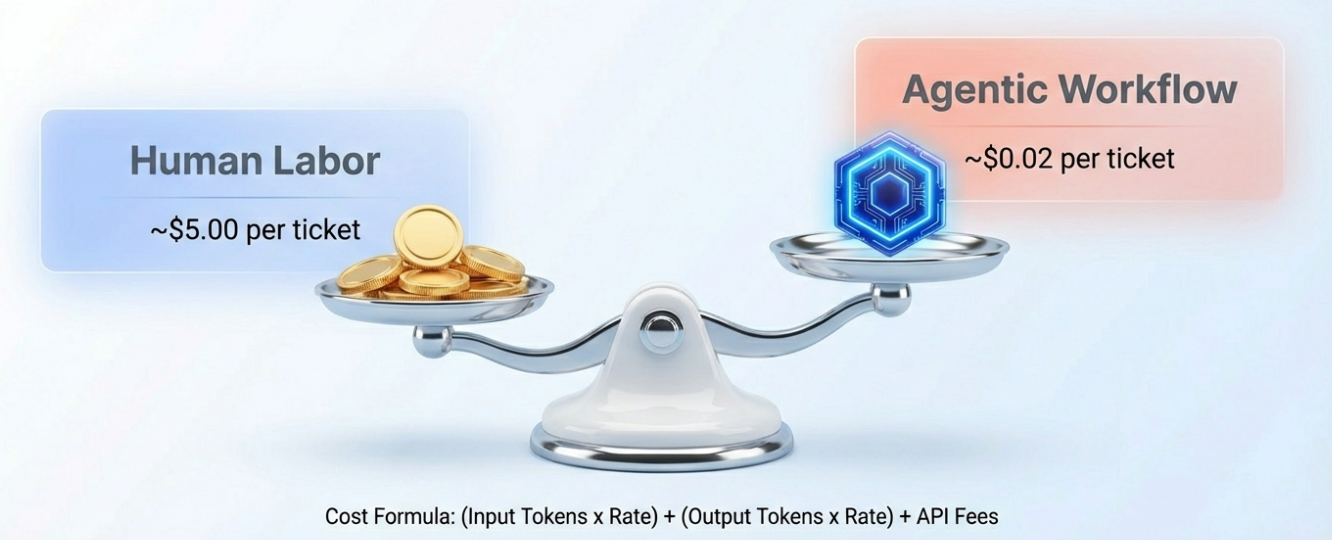
The Agentic Cost Formula:
Example Scenario:
Human Cost: A support analyst takes 10 minutes to resolve a ticket. At $30/hour, that ticket costs $5.00.
Agent Cost: An agent running GPT-4o uses 2,000 input tokens and 500 output tokens.
Cost: ~$0.02 per transaction.
The Verdict: Even with high token consumption, the agent is 250x cheaper than human labor for the same task. However, if you use agents for millions of low-value tasks (like simple routing), the bill will accumulate. Use "Model Routing"—smaller models for simple tasks, and heavy hitters only for complex reasoning.
Future Trends in the Intelligent Automation Ecosystem
The field is moving fast. Here is what is coming in 2026.
The rise of multi-agent orchestration systems
We are moving from "One Agent" to "Agent Swarms." You will have a "Coder Agent," a "Reviewer Agent," and a "Manager Agent." They will collaborate to solve problems. The Manager breaks down the task, the Coder writes the script, and the Reviewer checks for bugs.
Evolution from Large Language Models to Large Action Models
Models are being trained specifically to use software. Soon, you won't need to build complex API connectors. You will simply show the Large Action Model a video of a human using Salesforce, and the model will learn to replicate the UI interactions natively.
Conclusion
Agentic automation is not just a buzzword, it is the necessary evolution of your IT stack. It bridges the gap between the rigid efficiency of RPA and the messy reality of unstructured enterprise data. But do not buy the magic. Build the architecture. Start small. Identify a process that is currently bleeding money due to manual exception handling. Audit your data. Define your guardrails. Move from "Scripted" to "Reasoning." The future of enterprise operations isn't about building better bots. It's about building digital workers that can think.
Frequently Asked Questions
Is Agentic Automation secure for enterprise data?
Yes, but only with the right architecture. You must use enterprise-grade LLMs that do not train on your data (zero-retention policies) and implement a middleware layer that redacts PII before it reaches the model. Never give an agent unrestricted access to production databases.
How does the cost of agentic automation compare to RPA?
Agentic automation has a higher variable cost (per-transaction token fees) but a significantly lower fixed cost (maintenance). RPA bots are cheap to run but expensive to fix when they break. Agents cost more to run but adapt to changes, reducing long-term technical debt.
Can I use my existing RPA tools with agentic workflows?
Absolutely. This is the "Orchestrated RPA" model. Use the agent as the "brain" to handle decision-making and unstructured data, then have the agent trigger your existing UiPath or Automation Anywhere bots to perform the final execution.
What is the difference between Generative AI and Agentic AI?
Generative AI produces content (text, images, code). Agentic AI produces outcomes (completed tasks, executed transactions). Agentic AI wraps Generative AI in a control loop that allows it to use tools and interact with the real world.
How do I prevent an agent from getting stuck in an infinite loop?
You must implement "Maximum Iteration" limits at the orchestration layer. For example, configure the agent to stop and escalate to a human if it hasn't solved the problem after 5 reasoning steps. This prevents runaway costs and stalled processes.