TL;DR
The Core Shift: We are moving from Deterministic Automation (RPA: "Do exactly X") to Probabilistic Autonomy (Agents: "Achieve Goal Y").
The Winning Architecture: Do not rip and replace.
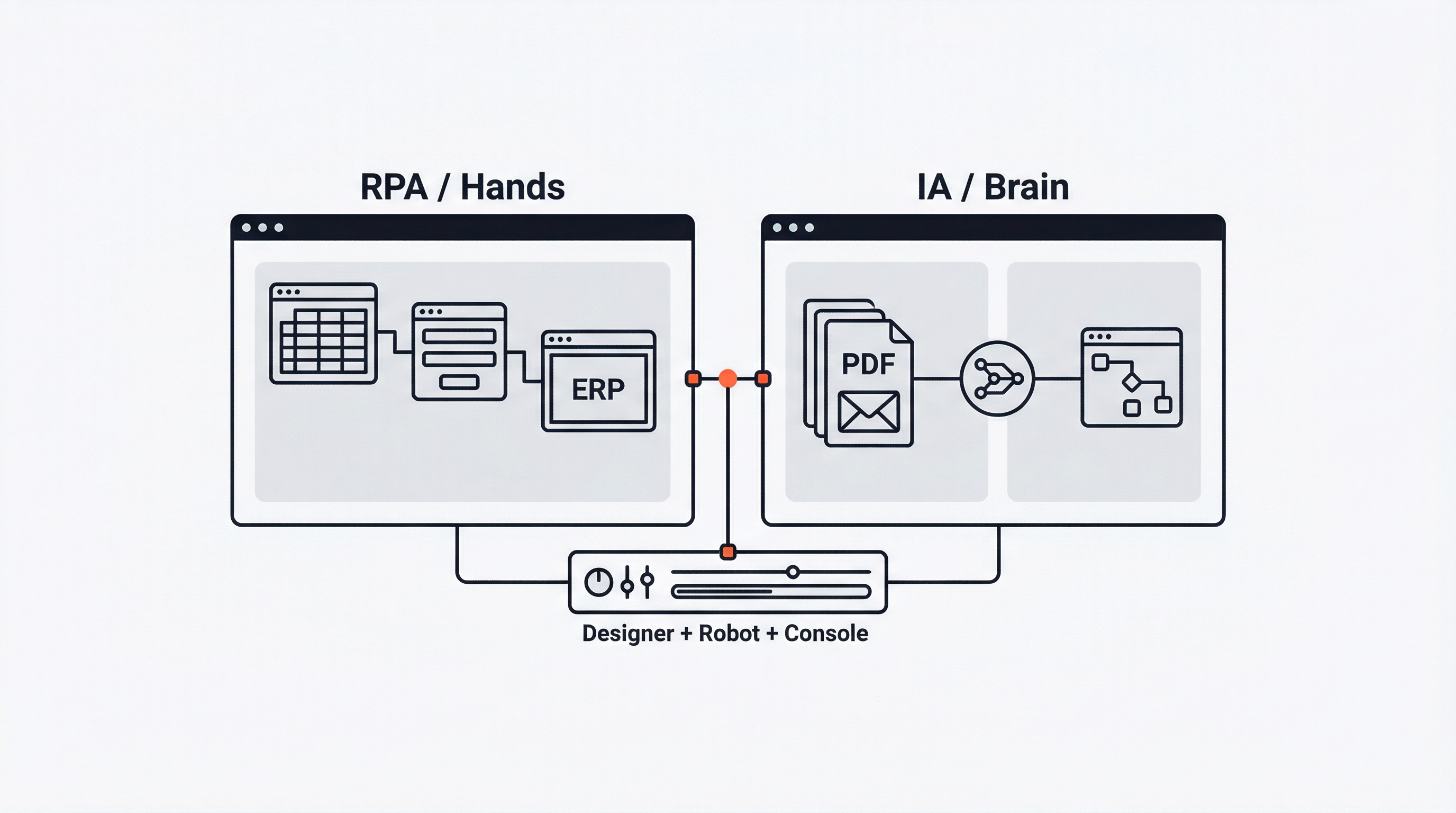
Use a "Sandwich Model": RPA handles high-speed ingestion/output. Agents handle the messy middle (reasoning/unstructured data).
ROI Impact: Hybrid workflows reduce maintenance costs by ~40% by eliminating brittle UI selectors, while increasing process coverage by 30% via unstructured data handling.
Risk: Agents introduce "hallucinations." Deployment requires strict JSON schema validation and Confidence Thresholds.
Your RPA portfolio may already feel like a collection of brittle bots: every UI change breaks a script, maintenance keeps growing, and leadership is asking whether AI agents can fix it. That is where Agentic AI vs RPA becomes an infrastructure decision, not a buzzword debate. RPA acts like the hands—fast, precise, and reliable for rule-based execution. Agentic AI acts like the brain—adaptive, reasoning, and useful when data is unstructured or interfaces change. The real choice is not one or the other, it is how to design a hybrid system where reasoning does not slow execution, and execution does not limit reasoning.
What is Robotic Process Automation?
Robotic Process Automation is deterministic software robotics. It mimics human interaction with digital systems through a user interface (UI) or API. It excels at high-volume, rule-based tasks where the input and output are strictly defined.
Think of RPA as a digital assembly line worker. If you tell an RPA bot to "Click Button A," it will click Button A. If Button A moves three pixels to the right, the bot fails. It does not think; it executes. This rigidity is its greatest strength (auditability) and its greatest weakness (fragility).
What is Agentic AI?
Agentic AI represents a shift from "scripted" to "goal-driven" automation. Unlike RPA, which follows a linear if-then-else sequence, an AI Agent receives a high-level objective (e.g., "Find the cheapest supplier for X and negotiate a discount").
The agent breaks this goal down into sub-tasks, plans a path, executes actions, and evaluates the feedback. If a website is down, an RPA bot crashes. An AI Agent attempts to find an alternative URL or waits and retries. It possesses a level of semantic understanding that allows it to navigate ambiguity.
The Evolution from Scripts to Reasoning
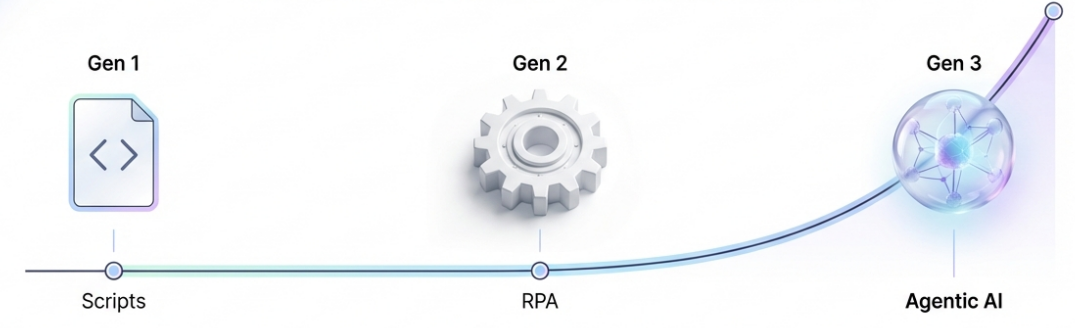
The Automation Evolution is moving from "Task Automation" to "Process Autonomy."
Gen 1 (Scripting): Python/Bash scripts.
Gen 2 (RPA): UI-based macros (UiPath, Automation Anywhere).
Gen 3 (Agentic): LLM-driven autonomous workers (Automa, AutoGPT).
According to Gartner’s 2024 Critical Capabilities for Automation, enterprises relying solely on legacy RPA face a "maintenance tax" consuming 40-50% of their automation budget. Furthermore, McKinsey's 2025 Technology Trends report indicates that generative AI integrations have the potential to automate 60-70% of work activities that consume employee time today—far surpassing the 20% cap of traditional RPA. The shift to reasoning engines is not about novelty; it is about slashing OpEx.
What Is the Difference between RPA and Agentic AI?
The distinction between Agentic AI vs. RPA is not just about intelligence; it is about data structure and error handling.
Handling Structured Versus Unstructured Data
RPA demands structure. It thrives on Excel sheets, SQL databases, and standardized forms. If you feed an RPA bot a messy email thread and ask it to "extract the sentiment," it fails.
Unstructured data processing is the domain of Agentic AI. Agents utilize Large Language Models (LLMs) to parse natural language, interpret images, and understand context.
RPA: Extracts data from Field A (Row 1, Col 2).
Agent: Reads a PDF invoice, understands that "Total Due" is at the bottom regardless of layout, and extracts it.
Comparing Deterministic Scripts and Probabilistic Outcomes
This is the most dangerous trap for CIOs. RPA is deterministic. Input A always equals Output B. This makes it perfect for financial ledgers where 1 cent of variance is unacceptable.
Agentic AI is probabilistic. It operates on statistical likelihood. Deterministic workflows guarantee consistency; AI agents guarantee adaptability. However, an Agent might answer a customer query differently on Tuesday than it did on Monday. You must decide where your organization can tolerate variance.
Adaptability to Interface Changes and Errors
UI change adaptation is the killer feature of Agentic AI. In traditional RPA, a changed CSS selector breaks the workflow. In Automa’s agentic workflows, the vision model "looks" at the page. If the "Login" button changes from blue to green or moves to the left, the Agent understands it is still the "Login" button and proceeds.
Feature | RPA | Agentic AI |
Data Type | Structured (Excel, SQL) | Unstructured (Email, PDF, Chat) |
Logic | Rule-based (If/Then) | Goal-driven (Reasoning) |
Error Mode | Stop/Crash (Requires Human Fix) | Retry/Self-Correct (Requires Guardrails) |
Maintenance | High (Brittle to UI changes) | Medium (Prompt tuning/Monitoring) |
When to Choose Which?
Do not let the AI hype train derail your stability. Use this decision logic to assign the right tool to the right problem.
When to Use RPA?
Speed is non-negotiable in high-frequency environments. RPA bots can execute transactions in milliseconds. AI Agents, reliant on LLM inference, suffer from latency (often 2-10 seconds per reasoning step).
Use RPA If:
Volume: You are processing >10,000 transactions/day (e.g., Claims Processing).
Audit: You require 100% explainability for compliance (e.g., SOX, HIPAA).
Stability: The target system is a legacy Mainframe/ERP that hasn't changed in 5 years.
When to Use Agentic AI?
You choose Agents when the rules are too complex to code or the inputs are too messy to map.
Use Agentic AI If:
Ambiguity: The input is natural language (Emails, Chat logs) or variable documents (Invoices).
Dynamic UI: The target website updates its DOM structure weekly.
Decision Making: The task requires judgment (e.g., "Review these 5 supplier quotes and pick the best value based on shipping time vs. cost").
Automation Suitability Scorecard
Use this scorecard to evaluate incoming automation requests.
Criteria | Score 1 (Use RPA) | Score 5 (Use Agentic AI) | Your Score |
Input Data | Highly Structured (SQL/CSV) | Highly Unstructured (Email/PDF) | |
Process Logic | Fixed Rules (If/Then) | Judgment Based (Reasoning) | |
UI Stability | Static (Legacy ERP) | Volatile (Modern SaaS/Web) | |
Volume | High (>10k/day) | Low/Medium (<1k/day) | |
Error Tolerance | Zero Tolerance | Low Tolerance (with Review) | |
Total Score | 5-15: Build RPA | 16-25: Build Agent |
Hybrid Automation: RPA + Agentic AI
The future is not binary. It is Hybrid RPA and agentic AI. The most successful architectures use Agents to handle the mess and RPA to handle the execution.
Integrating RPA and AI for Maximum ROI
Integrating RPA with AI allows you to leverage the speed of bots and the intelligence of agents.
Pattern: The "Sandwich" Model.
RPA (Input): Scrapes raw data from a legacy ERP (fast, cheap).
Agent (Process): Analyzes the data, spots anomalies, and formats a report (intelligent).
RPA (Output): Uploads the report to a government portal (precise).
Technical Deep Dive: The JSON Handshake
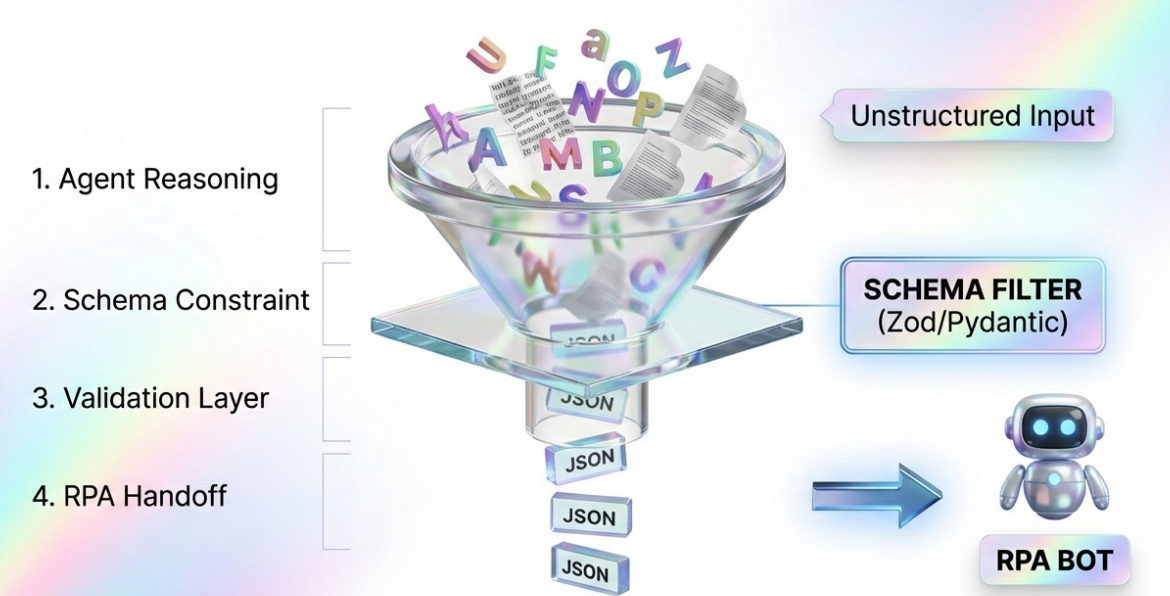
To prevent the "Black Box" problem, you must constrain how the Agent talks to the RPA bot. Do not let the Agent output free text.
Implementation Pattern: When the Agent finishes its reasoning, force it to output a structured JSON object validated against a schema.
Step 1: Agent analyzes email.
Step 2: Agent is prompted: "Extract data in JSON format matching Schema {InvoiceID: string, Amount: number}".
Step 3: A validation layer (e.g., Zod or Pydantic) checks the JSON.
Step 4: If valid, the RPA bot accepts the variables. If invalid, the Agent is prompted to retry.
This ensures that the thinking handles the variability, while the doing remains audit-proof.
Risk Management & Governance for Agentic AI
Deploying Agents without governance is an invitation to disaster. Unlike RPA, which fails silently (crashes), Agents can fail confidently (hallucinations). You must build a "Governance Layer" into your architecture.
Hallucination Control
Never let an Agent rely solely on its training data for business facts. Use RAG (Retrieval-Augmented Generation) to ground the Agent.
Mechanism: The Agent must query your internal Knowledge Base (Vector DB) before answering.
Constraint: Instruct the model: "Answer only using the provided context. If the answer is not found, output NULL." This prevents creative fabrication.
Confidence Thresholds & HITL
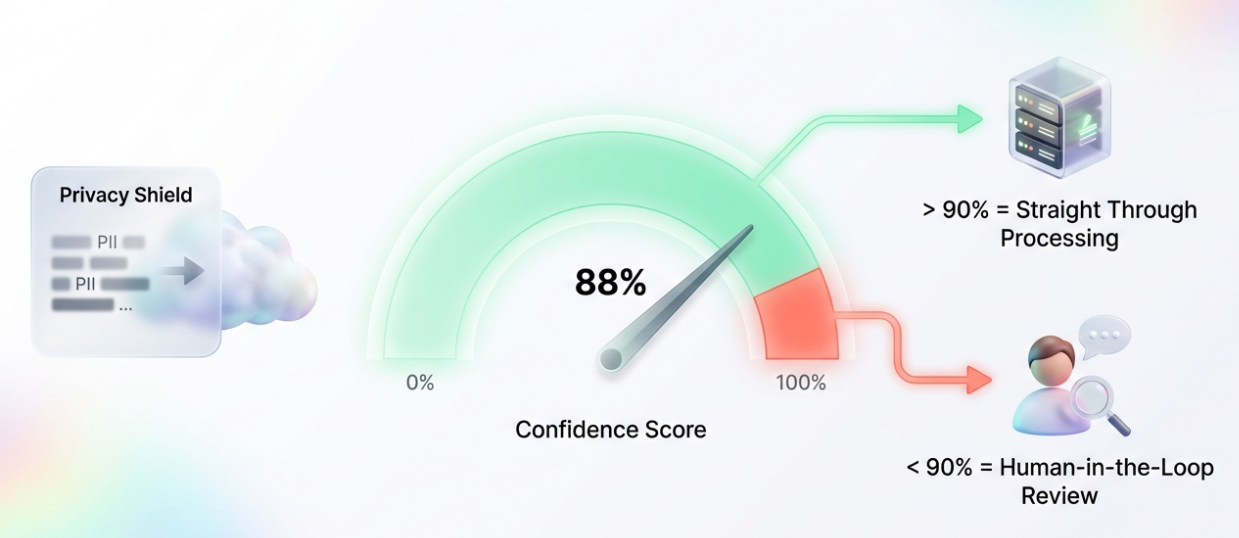
Implement a Human-in-the-Loop (HITL) protocol based on confidence scores.
High Confidence (>90%): Straight-through processing (STP) to RPA execution.
Low Confidence (<90%): Route to a human review queue (Slack/Teams integration).
Financial Guardrails: Hard-code rules in the orchestration layer (e.g., "Any transfer >$1,000 requires human approval regardless of AI confidence").
Data Privacy (PII Redaction)
Before sending data to an LLM (especially public models like GPT-4), strip Personally Identifiable Information (PII).
Technique: Use a local regex script or a lightweight local NLP model (like BERT) to replace names/SSNs with placeholders (e.g., [CLIENT_NAME]) before the API call. Re-inject the real data during the final RPA execution step.
2 Case Studies: Agentic AI + RPA
Global Logistics Firm Reduces Manual Entry by 70%
Context: A mid-sized logistics company processing 4,000 Bills of Lading (BOL) monthly.
The Problem: BOLs came from 50 different carriers in PDF, JPG, and Email formats. Legacy RPA (OCR) failed 40% of the time due to layout variations, requiring a team of 6 humans to manually review.
The Hybrid Solution:
Trigger: RPA bot monitors the "Inbound" email folder.
Processing: An Agentic Workflow (using GPT-4o Vision) analyzes the document. It identifies the "Shipper," "Consignee," and "Weight" regardless of where they appear on the page.
Execution: The Agent outputs a standardized JSON. The RPA bot takes that JSON and inputs it into the legacy TMS (Transportation Management System).
The Result:
Accuracy: Improved from 60% to 98%.
Cost: Reduced cost-per-document from $4.50 (human) to $0.45 (Hybrid).
ROI: Full implementation paid for itself in 3 months.
FinTech Firm Automates Contract Risk Audit
Context: A financial services provider needed to audit 5,000+ vendor contracts for GDPR compliance clauses.
The Problem: Manual review by legal associates took 45 minutes per contract. Traditional RPA could not understand legal phrasing variations (e.g., "Data Protection" vs. "Privacy Safeguards").
The Agentic Solution:
Ingestion: RPA scripts bulk-uploaded PDFs to a secure local vector database.
Analysis: A Local LLM (Llama 3 via Ollama) acted as the Agent, scoring each contract against a 12-point compliance checklist.
Review: The Agent flagged only "High Risk" contracts for human review.
The Result:
Velocity: Audit time reduced from 3,750 hours to 48 hours.
Risk Reduction: Identified 140 non-compliant contracts that manual review had previously missed.
Security: Zero data left the company's on-premise server.
Cost Analysis and ROI Considerations
You cannot scale what you cannot afford. The cost models for these two technologies are fundamentally different.
Analyzing License Costs Versus Token Consumption
RPA maintenance cost is usually a fixed annual license per bot runner. You pay whether the bot works or sleeps. AI development costs are variable. You pay per "Token" (input/output volume) or per API call.
The Trap: An Agent reading a 50-page document might cost $0.50 in API tokens. If you run that 10,000 times a day, your OpEx explodes.
The Fix: Use RPA for the bulk. Only call the Agent (consume tokens) for the specific data points that require reasoning. Do not use an LLM to extract a date if a Regex script can do it for free.
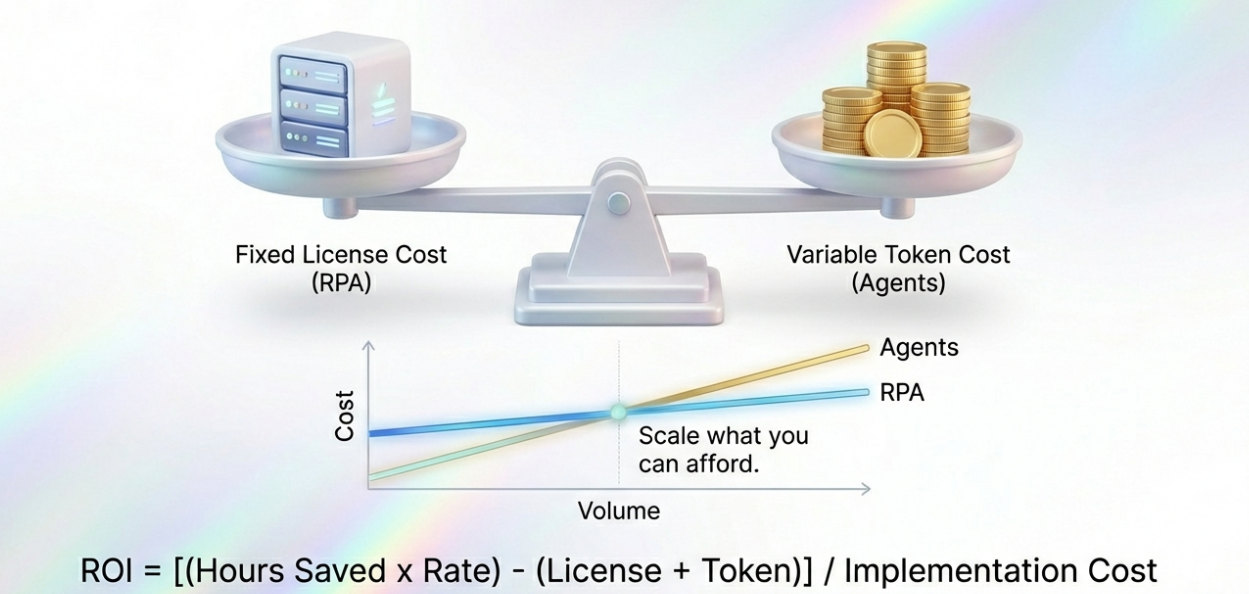
Break-Even Analysis: RPA vs. Agentic AI
Below is a model comparing a standard invoice processing task.
Cost Component | Traditional RPA | Agentic AI (LLM) |
Setup Cost | High ($15k - $50k dev time) | Low ($2k - $5k prompt eng) |
Maintenance | High (Fixing selectors: $5k/yr) | Low (Prompt tuning: $1k/yr) |
Run Cost (Low Vol) | High (License fees dominate) | Low (Pay per token) |
Run Cost (High Vol) | Low (Zero marginal cost) | High (Linear token scaling) |
Ideal Volume | > 5,000 runs/month | < 5,000 runs/month |
Step-by-Step Migration Guide: From RPA to Agentic
Your strategy for 2025 should not be to rip and replace, but to augment and orchestrate. Follow this roadmap to migrate safely.
Phase 1: The Audit (Weeks 1-2)
Don't guess; look at the logs. Identify RPA bots with the highest failure rates.
Action: Pull error logs from your RPA orchestrator.
Target: Isolate bots failing due to "Selector Not Found" or "Timeout" (UI changes). These are your prime candidates for Agentic replacement.
Phase 2: The Pilot (Weeks 3-6)
Select a Low-Risk, High-Variance process.
Example: "Competitor Price Monitoring."
Implementation: Replace the scraping logic with an Automa AI block. Keep the Excel reporting logic in RPA.
Goal: Prove that the Agent can handle UI changes without crashing.
Phase 3: The Governance Layer (Weeks 7-8)
Before scaling, establish the "Human-in-the-Loop" protocol.
Rule: Any Agent-initiated financial transaction over $500 must be routed to a Slack channel for human approval (Yes/No button) before the RPA bot executes the payment.
Phase 4: Scaling (Month 3+)
Move to a unified platform. Stop maintaining separate silos for Scripts and Agents. Use orchestration tools that support both Python/RPA logic and LLM chaining in a single canvas.
Conclusion
The debate of Agentic AI vs. RPA is not a zero-sum game; it is an architectural evolution. RPA provides the muscle—reliable, fast, and compliant. Agentic AI provides the nervous system—adaptive, intelligent, and resilient.
Enterprises that cling solely to deterministic scripts will drown in maintenance costs. Those that pivot to a hybrid architecture will build a workforce that heals itself.
Ready to modernize your automation stack? Don't just automate tasks; automate decisions. Start building your hybrid workforce with Automa today to ensure your automation strategy is as resilient as it is intelligent.
Frequently Asked Questions About Automation
Is Agentic AI More Expensive Than RPA?
It depends on the volume. RPA has high fixed license costs but near-zero marginal costs per run. Agentic AI has low upfront costs but incurs "token costs" for every execution. For extremely high-volume, simple tasks, RPA is cheaper. For complex, low-volume tasks, Agentic AI offers better ROI.
Can Existing RPA Bots Be Upgraded to Agents?
Yes. You don't need to delete your bots. Modern platforms like Automa allow you to inject AI steps into existing workflows. You can replace a fragile "Screen Scrape" step with a robust "AI Vision" step while keeping the rest of the RPA logic intact.
How Secure Are AI Agents with Sensitive Data?
Security depends on the deployment model. Public LLMs pose data privacy risks. However, enterprise-grade Agentic solutions allow you to use "Local LLMs" or private instances (via Azure/AWS) where data never leaves your secure perimeter. Always ensure your automation platform creates an audit log of the AI's reasoning process.