Key Takeaways
Core Value: RPA typically delivers 30-50% operational cost reduction while achieving near 100% data accuracy.
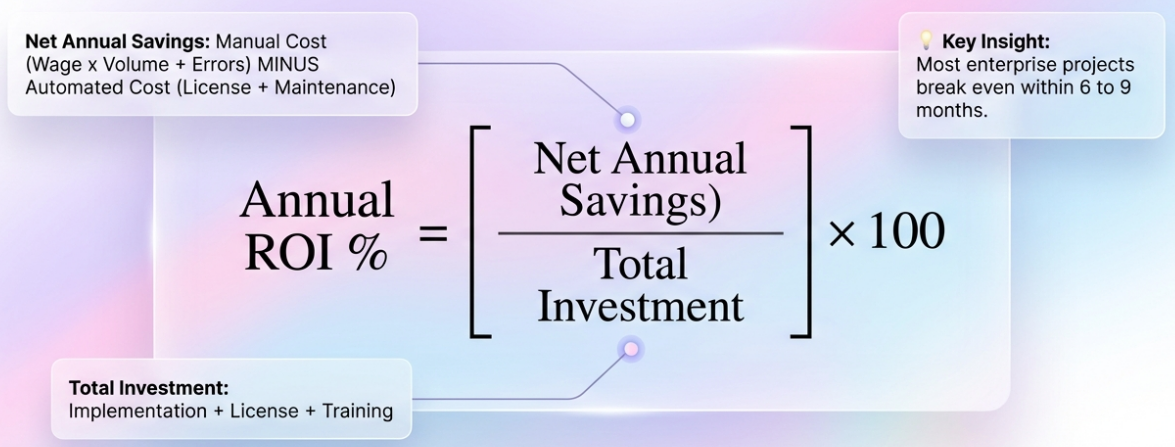
ROI Timeline: Most enterprise projects break even within 6 to 9 months.
Strategic Fit: Best suited for high-volume, rule-based processes (e.g., Invoice Processing, Claims) on legacy systems lacking APIs.
Critical Risk: Maintenance costs are often underestimated. Budget 15-20% of initial dev costs annually for bot updates.
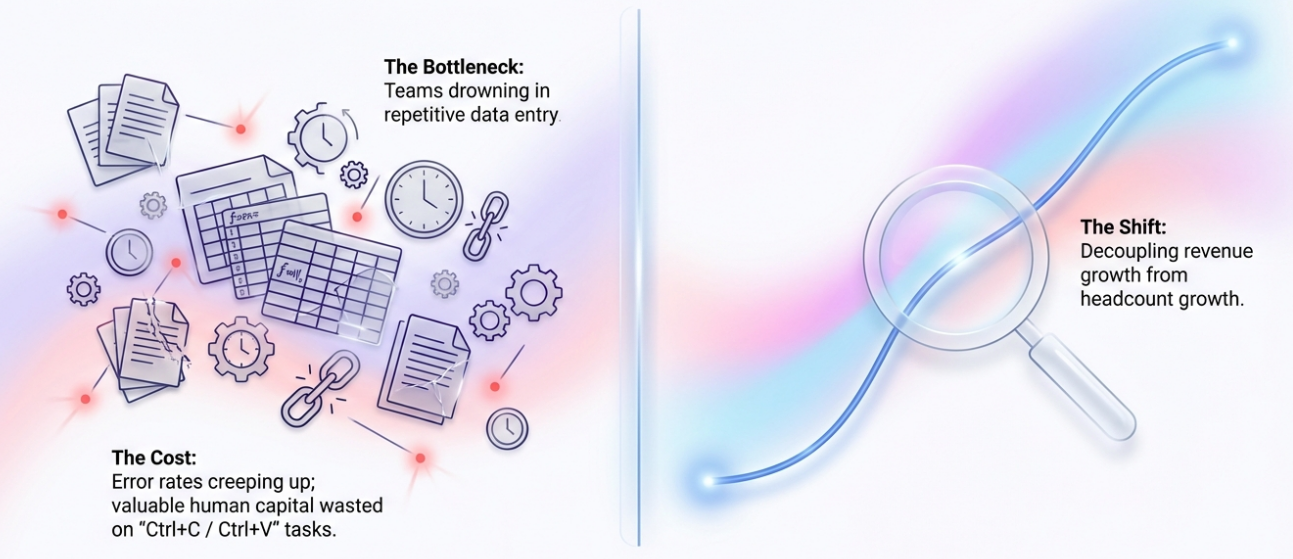
You are staring at a spreadsheet, trying to justify next quarter’s budget to your CFO. You know automation is necessary. Your team is drowning in repetitive data entry, and the error rates are creeping up. But "we need to be more efficient" isn't a business case. It’s a wish. To get the green light, you need hard numbers. You need to prove that Robotic Process Automation benefits go beyond buzzwords and translate directly into the P&L statement.
This isn't about replacing humans with robots. It is about removing the "robot" from the human.
We are going to dismantle the fluff surrounding automation. This guide provides the exact formulas to calculate RPA ROI, identifies the hidden costs most vendors won't tell you about, and maps out a strategy to secure your stakeholder buy-in.
What is Robotic Process Automation?
Stop thinking of RPA as just software. Think of it as a digital workforce that sits on top of your existing IT infrastructure.
Understanding the Digital Workforce
What is RPA? At its core, RPA involves deploying software bots that mimic human interactions with digital systems. They click, type, copy, and paste. But unlike a human, a digital workforce operates 24/7/365 without coffee breaks, vacations, or distractions.
For an IT Director, this means legacy system integration without expensive API development. For a Finance Head, it means closing the books in two days instead of ten. These bots act as the "hands" of your digital operation, executing rule-based tasks with pixel-perfect precision.
How Bots Actually "See" Unlike standard scripts, modern RPA bots don't just rely on screen coordinates (which break easily). They utilize:
DOM/Object Selection: Interacting directly with the underlying HTML tags or Windows application IDs.
Computer Vision (CV): Using AI to "look" at a remote desktop (Citrix/RDP) to identify buttons and text fields visually, similar to a human eye.
OCR (Optical Character Recognition): Converting scanned PDFs into structured data streams.
RPA vs Workflow Automation Differences
Many leaders confuse these two. Here is the breakdown.
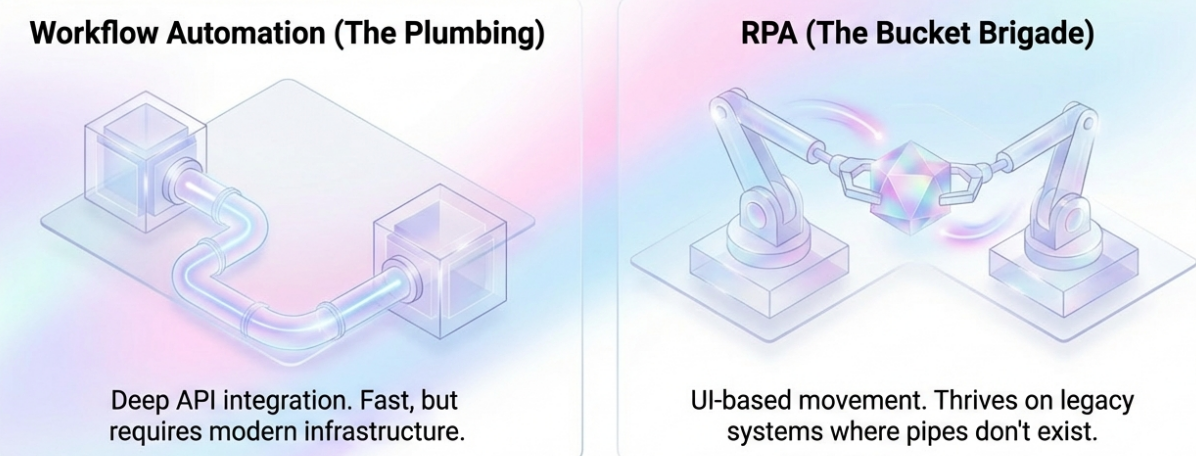
Workflow automation is like the plumbing of a house. It connects systems deeply via APIs (e.g., when a lead hits Salesforce, an email is automatically sent via HubSpot). It is fast and robust but requires technical access and structured data.
RPA is the contractor who walks into the house and manually flips the switches. It works on the user interface (UI) layer. If you have a legacy ERP system that doesn't have an API, workflow automation fails. RPA thrives here.
Think of it this way:
Workflow Automation: The pipe that carries water directly from the city main to your tap.
RPA: The bucket brigade that moves water when the pipes haven't been built yet.
You often need both. But for immediate relief on legacy systems, RPA is the faster path to value.
Top 9 RPA Benefits for Business Growth
Why is the global RPA market projected to exceed $30 billion by 2030 (Grand View Research)? It’s not just about speed. It’s about predictability. Let’s look at the core Robotic Process Automation benefits backed by data.
Significant Cost Reduction Strategies
The most immediate impact is on your bottom line. RPA benefits your budget by decoupling revenue growth from headcount growth.
According to Deloitte’s Global Intelligent Automation Survey, organizations implementing RPA at scale report an average cost reduction of 32% in impacted areas. This isn't magic. It's math. A software bot costs a fraction of a full-time employee's loaded cost (salary, benefits, office space) and produces three times the output. Cost reduction here is structural, not temporary.
Eliminate Human Error for Accuracy
Human error is expensive. A typo in an invoice or a misplaced decimal in a compliance report can cost thousands in fines or lost revenue.
Bots follow rules. If the rule is "Copy cell A1 to field B2," they do it 10 million times without deviation. Accuracy reaches 100% for standardized processes. One of our logistics clients reduced their shipping manifest errors from 4% to 0.01% in six weeks, saving them $120,000 annually in return logistics.
Boost Employee Productivity and Morale
There is a fear that robots steal jobs. Address this head-on. McKinsey research indicates that while fewer than 5% of occupations can be entirely automated, about 60% of occupations have at least 30% of constituent activities that can be automated.
Employee productivity skyrockets when you remove the drudgery. No one went to college to copy-paste data from a PDF into Excel. When you automate the boring stuff, your team focuses on high-value analysis and strategy.
Manager's Said: "We aren't automating you out of a job. We are automating the parts of the job you hate so you can focus on the work that gets you promoted."
Ensure Compliance and Security
Every action a bot takes is logged. This creates a perfect digital audit trail. For industries like banking or healthcare, compliance isn't optional. RPA ensures that every process step adheres strictly to regulatory standards, reducing the risk of fines. Security is tighter because sensitive data is handled by a bot, not viewed by multiple human eyes.
Achieve Scalability During Peak Seasons
Black Friday? Tax season? End-of-month close?
Usually, you have to hire temp staff, train them, and hope they don't mess up. With RPA, scalability is instant. You simply spin up more bots. When the volume drops, you turn them off. Business scalability becomes a software setting rather than a hiring crisis.
Improve Customer Satisfaction Scores
Speed matters. If a customer applies for a loan or a refund, they want an answer now. RPA reduces cycle times from days to minutes. Higher speed equals higher customer satisfaction.
Seamless Integration with Legacy Systems
This is often the deciding factor for IT Directors. Most enterprises run on a mix of modern SaaS and ancient legacy systems (Mainframes, AS/400, Custom ERPs). Rewriting these systems costs millions and takes years.
RPA is non-invasive. It operates at the UI layer, meaning you don't need to alter the underlying database or application code. It bridges the gap between your 30-year-old ERP and your modern CRM in weeks, not years.
Enhanced Data Analytics & Process Insights
You cannot manage what you do not measure. Manual processes are "black boxes"—you only see the input and the output.
RPA bots generate granular logs for every step of a transaction. This data allows for Process Mining, revealing bottlenecks you didn't know existed. For example, you might discover that 40% of your invoice processing time is spent handling "Vendor Code Mismatches," allowing you to fix the root cause upstream.
24/7 Availability & Business Continuity
Humans need sleep. Bots do not. By deploying a digital workforce, you can adopt a "follow-the-sun" model without hiring overseas teams. Processes like nightly data backups, report generation, or global inventory synchronization can occur at 3:00 AM, ensuring that when your human staff logs in at 9:00 AM, the work is already done.
How to Calculate RPA ROI Accurately?
This is the section where most business cases fail. Vague promises don't get funded. You need a solid RPA ROI model.
Key Metrics for RPA Investment
Before you build the formula, gather these inputs:
FTE Loaded Cost: Salary + Benefits + Overhead.
Average Handling Time (AHT): How long does the human take per transaction?
Volume: Transactions per month.
Error Rework Cost: (Time spent fixing errors) x (Hourly rate).
Implementation Cost: License + Developer hours + Infrastructure.
These ROI metrics are your ammunition.
Step by Step ROI Calculation Formula
Here is the formula we use at Automa to prove value.
Annual ROI % = [(Net Annual Savings) / (Total Investment)] x 100
Let's break down Net Annual Savings: Net Savings = (Cost of Manual Process) - (Cost of Automated Process)
Cost of Manual Process:
(Hours per task * Monthly Volume * 12 months * Hourly Wage) + (Error Rework Costs)Cost of Automated Process:
(Annual License Fee) + (Annual Maintenance) + (Infrastructure Costs)
Total Investment (Year 1): Implementation Cost (Setup/Dev) + Annual License Fee + Training Costs
ROI Scenario: The "Invoice Bot"
Metric | Manual Process | Automated Process |
Staffing | 3 FTEs ($50k/yr each) | 0.2 FTE (Supervisor) |
Cost Basis | $150,000 / year | $10,000 (Maintenance) |
Setup Cost | $0 | $50,000 (Year 1 License + Dev) |
Total Year 1 Cost | $150,000 | $60,000 |
Net Savings | - | $90,000 |
ROI % | - | 180% |
Use this logic. CFOs love this logic.
Hidden Costs You Must Consider
Be careful. The sticker price of the software is not the total cost. Gartner warns that IT leaders often underestimate the ongoing costs of RPA.
Maintenance costs are the silent killer of ROI. Processes change. The UI of your ERP updates. When the screen changes, the bot breaks. You must budget for "Bot Maintenance." A good rule of thumb is to allocate 15-20% of the initial development cost annually for maintenance. If you ignore this, your RPA ROI will turn negative by Year 2.
High Impact RPA Use Cases by Industry
Where should you start? Look for high-volume, low-variance tasks.
Finance and Accounting Automation
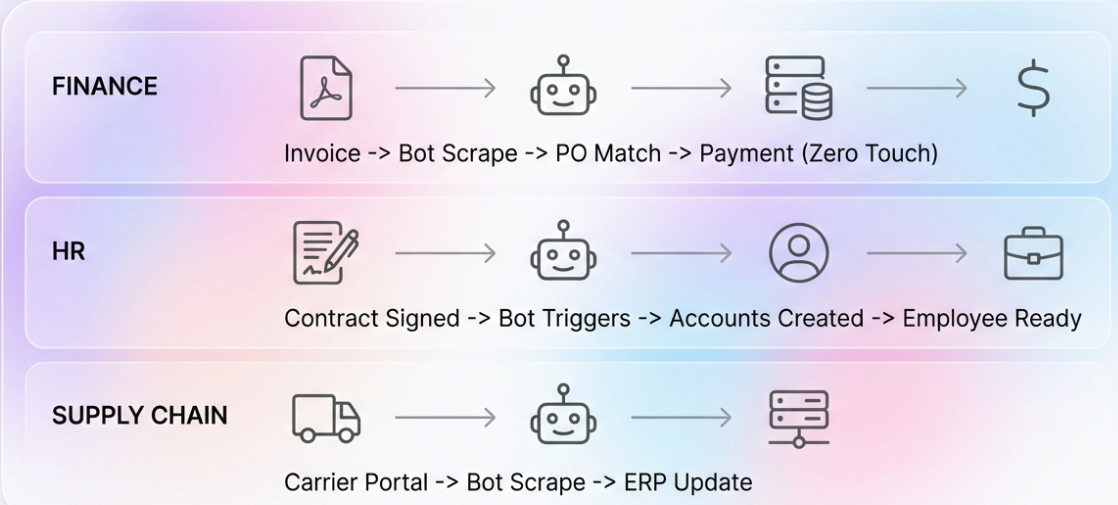
This is the "low-hanging fruit." Invoice processing is the classic example. Bots can scrape data from PDF invoices, match them against Purchase Orders (PO) in the ERP, and schedule the payment.
RPA use cases in Finance also include: Expense report auditing, bank reconciliation, and tax reporting.
HR and Onboarding Processes
Onboarding automation transforms the new hire experience. Instead of HR manually creating accounts for email, Slack, Zoom, and the HRIS, a bot triggers the entire sequence the moment the contract is signed. It saves HR about 4-5 hours per new hire.
Customer Service and Support
Agents spend 40% of their time "Alt-Tabbing" between systems to find customer data. RPA bots can act as a "sidekick," pulling data from five different legacy systems into a single view for the agent. Customer service becomes faster and more empathetic because the agent is looking at the customer, not the screen.
Healthcare and Patient Administration
The healthcare sector is plagued by paperwork. RPA is revolutionizing claims processing and patient scheduling.
Claims: Bots verify insurance eligibility across multiple payer portals in seconds, reducing claim denials.
Records: Automating the transfer of patient data between disparate EMR (Electronic Medical Record) systems ensures doctors have the right history without manual data entry errors.
Supply Chain and Logistics
In supply chain, the gap between the ERP and the real world is often bridged by email and spreadsheets.
Order Tracking: Bots can log into carrier portals (FedEx, UPS, DHL), scrape tracking statuses, and update the internal ERP automatically.
Inventory Management: Automating the reorder process when stock levels hit a defined threshold, ensuring production never stops due to missing parts.
Steps to Implement RPA Successfully
You have the budget. Now, how do you ensure you don't fail?
Identify the Right Processes to Automate
Not everything should be automated. Use the Automa Quadrant to filter:
High Volume / Low Complexity: Automate First. (e.g., Invoice Entry)
High Volume / High Complexity: Optimize, then Automate. (e.g., Claims Processing)
Low Volume / Low Complexity: Do Not Automate. (Just do it manually).
Low Volume / High Complexity: Human Expert Required.
Readiness Checklist
Before writing a single line of code, run your process through this filter:
Is the process rule-based? (No subjective decision making)
Is the data structured? (Excel, Database, Standard forms vs. Handwritten notes)
Is the process stable? (The UI/Process doesn't change every week)
Is the volume high enough? (Does the ROI justify the dev cost?)
Choose the Best RPA Tools
The market is flooded with RPA tools.
Low-Code Platforms: Great for citizen developers and simple tasks.
Enterprise Platforms: Necessary for complex, high-security, scalable operations.
Managed Solutions: Best for teams that want the outcome without managing the infrastructure.
Avoid Common Implementation Pitfalls
RPA failure rates are high (some estimate 30-50%). Why?
Automating Broken Processes: If you automate a bad process, you just get bad results faster. Fix the process first.
Ignoring IT Security: Shadow IT kills projects. Involve InfoSec from Day 1.
Lack of Documentation: If the process isn't documented step-by-step, the bot developer is guessing.
Future of RPA and Intelligent Automation
The field is moving fast. We are shifting from "Doers" to "Thinkers."
Integrating AI with RPA Bots
Traditional RPA is blind. It needs structured data. Intelligent Automation combines RPA with AI (Artificial Intelligence).
With Generative AI and OCR (Optical Character Recognition), bots can now "read" unstructured emails, "understand" the sentiment of a customer complaint, and make decisions. We are moving from simple scripts to autonomous agents. This evolution will unlock the next tier of RPA benefits, allowing you to automate complex decision-making processes, not just data entry.
Your Next Strategic Move
The question is no longer if you should use automation, but how fast you can deploy it correctly. The RPA benefits, cost reduction, accuracy, and scalability, are proven. The math works.
But the execution is where the battle is won.
Don't start with a massive, multi-year overhaul. Start with one high-impact process. Calculate the RPA ROI using the formula above. Prove the win. Then scale.
If you are ready to build a business case that your CFO cannot refuse, or if you need to identify which of your processes are bleeding money, explore Automa’s enterprise pricing today. Let’s turn that spreadsheet into a strategy.
FAQ
What is the average payback period for an RPA investment?
For most well-scoped projects, the payback period is typically between 6 to 9 months. Projects that focus on high-volume, repetitive tasks like invoice processing can see ROI in as little as 3 months.
Can RPA work with my old legacy systems?
Yes. This is RPA's superpower. It interacts with the user interface (UI), so it works with green-screen terminals, mainframes, and custom apps without needing an API or backend database access.
How does RPA differ from AI?
RPA is the "hands"—it follows strict, pre-defined rules to execute tasks. AI is the "brain"—it can learn, analyze unstructured data, and make probabilistic decisions. Intelligent Automation combines both.
What are the biggest risks in RPA implementation?
The biggest risks are poor process selection (automating a process that changes frequently) and underestimating maintenance costs. Bots need updates whenever the underlying software they interact with changes.
Do I need to know how to code to use RPA?
Not necessarily. Many modern RPA tools offer "drag-and-drop" interfaces for simple workflows. However, for complex, enterprise-grade automation involving exception handling and security, technical expertise is strongly recommended.